

Key Takeaways
- For a service pit less than 10 feet deep, OSHA does not always require a fall protection system, but it does require strict conditions if you skip one.
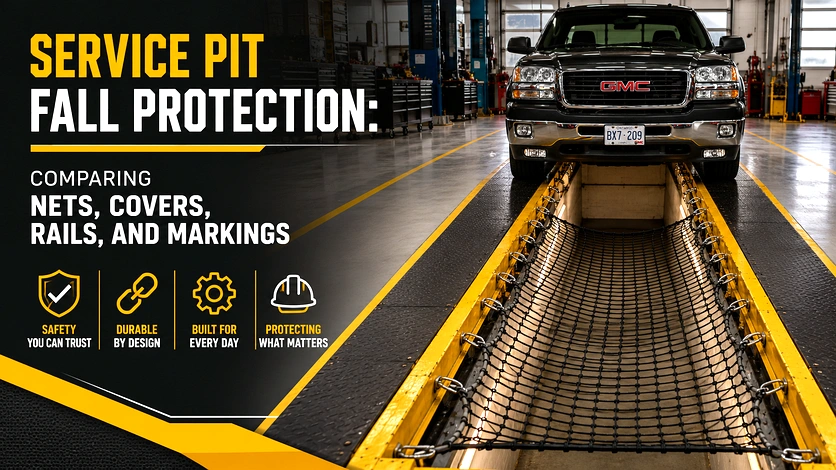
- There are five practical ways to guard a pit: covers, safety nets, guardrails, personal fall protection, and floor markings with signage.
- Covers must support twice the maximum intended load and be secured. A safety net is a fall protection system, not a walking surface.
- Guardrails work poorly on drive-over bays, because they must be removed for the vehicle, which exposes whoever moves them.
- The right answer depends on pit depth, whether vehicles drive over it, and how often it is used. No single method wins every time.
Updated: June 2026

What Does OSHA Actually Require for a Service Pit?
For a repair, service, or assembly pit less than 10 feet deep, OSHA does not require a fall protection system, provided you meet three specific conditions. If you cannot meet all three, you must guard the pit.
The rule is 1910.28(b)(8). To skip a fall protection system on a pit under 10 feet, an employer must limit access within 6 feet of the pit edge to authorized, trained employees; apply contrasting floor markings at least 6 feet from the edge, or a warning line at least 6 feet out on stanchions that resist 16 pounds of horizontal force, or both; and post visible caution signs reading "Caution - Open Pit."
That is the whole exemption. Miss any one of those three and you are back to guarding the opening, whether with a cover, a guardrail, a pit safety net, or a personal fall protection system.
Worth knowing: deeper pits are treated differently, and a pit is still an open hole in a floor that people walk past all day. Meeting the minimum is not the same as eliminating the hazard.
How Do Pit Covers and Safety Nets Differ?
A cover closes the hole and can carry weight. A net catches a person but is not a floor. OSHA treats them as different things, and mixing them up is the most common mistake.
Covers
Under 1910.29(e), a cover must support at least twice the maximum intended load and be secured against accidental displacement. That is a real engineering requirement, and it is why steel plate, aluminum, and grating covers are heavy.
The upside is total closure: nothing and nobody goes in, and a properly rated cover can be walked on or driven over. The downside is weight, storage, and time. Manual handling of heavy panels is its own injury risk, and a cover that is awkward to fit is a cover that stops getting fitted.
Safety Nets
A net is a fall protection system, not a cover. It is designed to catch a falling person, and it must meet the safety net criteria OSHA points to in 1910.29(c). It is light, fast to deploy, and does not need overhead anchor points.
What a net does not do is act as a floor. You cannot stand on it, stack tools on it, or drive over it, and a fine-mesh net is needed if you also want to stop small dropped parts. If your goal is a load-bearing surface across the pit, a net is the wrong tool.


Guardrails, Fall Arrest, and Floor Markings
These three round out the options. Guardrails are strong but clash with drive-over bays, fall arrest rarely has the clearance to work in a shallow pit, and markings protect nobody physically.
Guardrails
OSHA sets a clear spec: top rails at 42 inches, plus or minus 3 inches, able to withstand 200 pounds of force without dropping below 39 inches. Toeboards around vehicle pits must be at least 2.5 inches, though OSHA allows omitting them where a toeboard would block access to a vehicle over the pit.
The catch is obvious in a service bay. Rails have to come down for the vehicle, and the person removing them is standing at an open edge while they do it. Guardrails suit walk-in inspection pits far better than drive-over bays.
Personal Fall Arrest
A harness needs somewhere to fall. In a pit only 5 or 6 feet deep, there is not enough clearance for an arrest system to deploy before the worker reaches the bottom. Travel restraint, which stops someone reaching the edge at all, is more realistic than arrest, but both need anchors most shops do not have.
Floor Markings and Signage
This is the 1910.28(b)(8) route, and it is legitimate. Caution signs must meet 1910.145, which specifies a yellow background with a black panel. Be clear-eyed about what it is, though: markings and signs change behavior, they do not stop a fall. A distracted step or a slip on spilled oil goes straight into the pit.
Weighing Up Your Options
Pit Guarding Methods Compared
| Method | How It Protects | Best For | Main Limitation |
|---|---|---|---|
| Solid or grated cover | Closes the hole; carries load | Pits you need to walk or drive across | Heavy, slow to fit, manual handling risk |
| Safety net | Catches a falling person | Pits opened often, where a cover would not get refitted | Not a walking or driving surface |
| Guardrails | Physical barrier at the edge | Walk-in inspection pits vehicles do not cross | Must be removed for vehicles, exposing the worker |
| Personal fall arrest | Arrests a fall via harness and anchor | Deep pits with proper anchor points | Shallow pits lack the clearance to arrest a fall |
| Markings and signage | Warns and restricts access | Pits under 10 feet, with trained authorized staff | No physical barrier; relies on behavior |
Choosing Protection That Fits How the Bay Is Used

What Are the Options for Guarding a Pit?
There are five realistic approaches: solid or grated covers, safety nets, guardrails, personal fall protection, and floor markings with signage. Each solves a different part of the problem, and each has a real drawback.
Most shops end up combining two of them. A pit that is open during a job and empty overnight has different needs than one that vehicles drive across all day.
The honest starting question is not "what do I buy" but "when is this pit actually exposed?" A pit only creates risk when it is open and someone is near it. How you answer that decides which method fits.


Where Do Safety Nets Fit Best, and Where Do They Not?
Nets fit pits that stay open for daily work but need protection when nobody is in them. They do not fit situations where you need a load-bearing surface across the opening.
A net earns its place when the pit is in regular use, a heavy cover would not realistically get fitted and refitted, and guardrails would be in the way of the vehicle. It goes across the opening quickly, it catches a person, and it comes back off when the pit is needed. Our oil change and service bay safety nets are built for exactly that pattern of use.
A net is the wrong call if you need to walk across the pit, park on it, or roll a toolbox over it. That is a cover requirement, and only a rated cover meets it. A net is also not the answer on its own if dropped tools and parts are your main worry, unless you specify a fine enough mesh.
Four Questions That Decide It
- How deep is the pit? Under 10 feet opens up the markings-and-signage route; deeper does not.
- Do vehicles drive over the opening? If yes, guardrails are impractical and you need a cover or a net.
- Do you need to walk or drive on the guard itself? If yes, only a rated cover will do.
- How often is the pit opened? Frequent use favors something fast, like a net. Rare use favors a fixed cover or rails.
Frequently Asked Questions About Service Pit Fall Protection
Does OSHA require a cover or net on every service pit?
Is a safety net the same as a pit cover?
Can you drive a vehicle over a pit safety net?
Why are guardrails a poor fit for drive-over service bays?
Why is a harness usually the wrong answer for a service pit?
Are floor markings enough on their own?
What guardrail height does OSHA require around a pit?
The Numbers Behind the Rules

The OSHA Numbers Worth Knowing
- 10 feet is the pit depth below which the markings-and-signage exemption can apply.
- 6 feet is how far floor markings or a warning line must sit from the pit edge.
- 16 pounds is the horizontal force a warning line stanchion must resist without tipping.
- Twice the maximum intended load is what any cover must support, and it must be secured.
- 42 inches, plus or minus 3 is guardrail top rail height, resisting 200 pounds of force.
- 2.5 inches is the minimum toeboard height around vehicle pits, unless it blocks vehicle access.
Guarding an Oil Change or Service Bay Pit
Fall Arrest
Rarely suits a shallow pit, because there is not enough clearance for a harness to arrest a fall.
Guardrails
Strong passive protection, but they must come down whenever a vehicle needs the bay.
Covers
Close the opening completely and can carry load, but they are heavy and slow to move.
Safety Nets
Catch a falling worker and deploy fast, but they are not a surface you can stand or drive on.
Markings and Signs
The lowest-cost route OSHA allows, but it is administrative only, with no physical barrier.
Conclusion
There is no single best way to guard a service pit. A rated cover is unbeatable if you need to cross the opening. Guardrails are excellent on a walk-in inspection pit. Markings and signage can satisfy OSHA on a shallow pit. And a net is hard to beat when the pit is opened constantly and anything heavy would simply stop being used.
The method that fails is the one your team stops using because it is too slow or too heavy. Start with pit depth, whether vehicles cross the opening, and how often it is opened. Then pick the guard that fits that reality. We supply safety nets for oil change and service bays, and we would rather tell you a cover suits you better than sell you the wrong thing.
Which Service Pit Net Cover Fits Your Bay?
Answer four practical questions. The selector will recommend a net-style pit cover configuration to discuss with your safety team and cover supplier.
1. What must the cover do?
This distinction is critical. Personnel fall protection and vehicle load support are different applications.
2. How often must the pit be opened?
Access frequency strongly affects the best operating style.
3. What is the pit layout like?
Rails, columns, lifts, stairs, drains, and non-square openings can require custom detailing.
4. What conditions will the net encounter?
Material and hardware selection should match the real operating environment.
Your Suggested Direction
Complete the questions above to reveal a recommendation.
Select one answer in each section
Your recommendation will appear here automatically. No JavaScript is used.
Retractable Net Pit Cover
Why this is likely the best fit
Your pit is opened frequently, has a relatively straightforward shape, and operates in typical indoor conditions. A retractable or roll-away net configuration can make daily access faster while maintaining a clear visual barrier when deployed.
Discuss: single-person operation, storage position, tensioning, attachment points, inspection access, and interference with lifts or tools.
Your selection points to
- High-frequency opening and closing
- Standard rectangular geometry
- Normal service-bay exposure
- Personnel fall-protection purpose
Removable Tensioned Net Cover
Why this is likely the best fit
Your pit has a straightforward shape and does not need to be opened constantly. A removable, securely tensioned net can provide a practical solution without the additional hardware of a frequently operated retractable system.
Discuss: attachment spacing, storage when removed, setup responsibilities, tension verification, and inspection procedures.
Your selection points to
- Occasional pit access
- Standard rectangular geometry
- Normal service-bay exposure
- Personnel fall-protection purpose
Custom-Engineered Net Cover
Why a custom review is appropriate
Your answers indicate irregular geometry, obstructions, or environmental exposure that may affect net material, edge protection, mounting hardware, or the way the cover opens. A measured, application-specific design is the safest direction.
Discuss: drawings and dimensions, cut-outs, segmented panels, chemical and temperature exposure, abrasion protection, anchorage, and operating procedure.
Likely custom factors
- Non-standard opening or obstructions
- Heat, chemicals, weather, or abrasion
- Special mounting or segmentation
- Site-specific operating constraints
A Personnel Net Cover Is Not a Load-Bearing Deck
Why the selector stopped here
A net-style personnel fall-protection cover should not be assumed to support vehicles, jacks, machinery, stored materials, or concentrated loads. That need calls for a separately engineered, load-rated covering system.
Do not use this recommendation as permission to drive or place equipment on a net. Have the application reviewed by a qualified supplier or engineer.
Next information to gather
- Maximum wheel and point loads
- Vehicle paths and axle spacing
- Pit dimensions and supporting structure
- Required access and removal method
Ready to Shop Service Pit Safety Nets?
Use the recommendation above as a starting point, then review available sizes and purchasing options on the product page.
View Service Pit Safety NetsNeed to Guard an Oil Change or Service Bay Pit?
We design and supply custom-sized safety nets for oil change and service bay pits across the United States. Tell us your pit dimensions and how the bay is used, and we will tell you honestly whether a net is the right fit or whether a cover would serve you better.
Get Your QuoteContains: BlogPosting + Person + FAQPage + Organization JSON-LD.
Visible in editor only. Do not duplicate or edit manually.
About the Author
Scott Fullerton is the Operations Manager at ALCO Construction Covers. With over 15 years of experience in industrial cover, net, and safety solutions, Scott oversees product development, technical specifications, and digital operations across the United States. He helps customers match the right pit protection to how their bays actually get used. Connect with Scott on LinkedIn.