

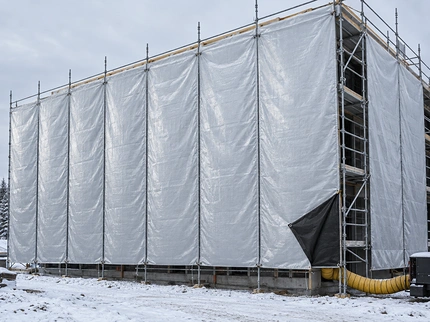
Insulated construction tarps are special covers that retain heat during cold weather. They harden concrete, keeps workers warm, and eliminate delays in construction work during winter. We design each tarps with inner layer made with air-filled bubbles that retains heat. The inside is made with strong, coated plastic fiber that guarantees protection from damage. For the edges, we fold and sew them twice, thus making them have high strength while workers can tie down or secure the tarps with the reinforced holes in the corner.
- The prices ranges from $83.99 to $271.99 per blanket, shipping included
- Sizes are between 6 x 25 ft and 12 x 25 ft sizes, and they have R1.84 to R7.74 rating
- They are customize and can be shipped immediately
- Comes with 2-year warranty on manufacturing defects
N Series and M Series Tarps

N Series - Black Both Sides
They are black on both sides with surface that does not show much light. They offer the best value for concrete work during residential construction projects, and area where you don’t want reflective tarp to reflect light.
- Have R1.84 to R3.0 rating
- Comes with foam or bubble core
- Budget curing near freezing
- 6 x 25 ft or 12 x 25 ft

M Series - Silver Reflective
It is design with a silver, reflective side, with black at the back. The silver side should be placed facing the concrete to reflect heat back into it.
- Guarantees between R2.8 to R7.74 insulation rating
- Features a foam, bubble, or combined layer
- Withstand temperatures between 10 to 30 °F nights, mostly in exposed or windy areas
- Perfect for keeping warming frozen ground and concrete warm
Quality You Can Rely On
Sizes
R-Value
Price
Ships
| Specification | Details |
|---|---|
| Material | High-strength coated woven polyethylene |
| Insulation | Closed-cell PE foam, bubble, or bubble and foam combo core |
| Color | Black both sides (N Series) or silver front and black back (M Series) |
| Edges | Hemmed and double stitched |
| Grommets | Heavy-duty grommets in the corners |
| Weather | Mildew and weather resistant, UV treated |
| FR rating | Not fire retardant |
| Reusable | 100% reusable |
| Custom sizes | Available on request, 10 to 14 workdays to produce |
| Warranty | 2 years on manufacturing defects |
Which R-Value Do You Need?
Match the R-value to your expected overnight low, then go up one level for strong wind, shaded sites or multi-day cures.
| Overnight Low | R-Value | Series |
|---|---|---|
| 35 to 45 °F | R1.8 to R2.5 | N Series |
| 25 to 35 °F | R2.8 to R3.4 | N or M Series |
| 10 to 25 °F | R5.1 to R5.6 | M Series |
| Below 10 °F or long cures | R6.0 and up, or two stacked | M Series |
R-values come from independent testing following ASTM C-518 or ASTM C-236 procedures. Actual performance varies with site conditions.
Bubble, Foam or Combo Core?
Bubble Core
They are lightweight, and are easy to use. They are a good choice for everyday concrete work and for blankets that you want to move between different jobs.
Foam Core
They provide better insulation and hold up well when people work over it. Works well for colder conditions and repeated use.
Combo Core
They are designed with two layers of bubbles and one layer of foam, with up to R5.11 insulation rating. Come with a good mix of lightweight design and strong insulation.
How Many Tarps Do You Need?
Plan Your Coverage
A 6 x 25 ft tarp covers 150 sq ft and a 12 x 25 ft tarp covers 300 sq ft. Overlap blankets by 3 to 6 in. and offset the seams if you stack layers.
For instance, a 60 x 100 ft slab is 6,000 sq ft. Laid in 12-ft-wide rows with overlaps, it takes about 24 of the 12 x 25 ft tarps.
Setup Tips
- Cover the concrete immediately after finishing to retain heat and moisture.
- Prevents cold air from getting to the beneath by securing the edges with weights or tape.
- Let the silver side face the concrete for M Series tarps.
- Don’t use an open flame under the blankets.
- Avoid thermal shock in very cold weather by removing the blankets slowly.
Construction Applications
Insulated construction tarps are affordable and effective way you can control temperature on job sites. You can use them to cover scaffolding, and build walls that help your workers remain warm. You can also use insulated construction tarps to protect equipments stored outdoors, cover pallets and insulate sand piles used for masonry work. They are also perfect for many other application on the construction site.
Common Questions
How effective are insulated tarps?
Insulated tarps are effective when their edges are properly sealed. This is because curing concrete or heaters uses inner layers to trap heat and maintain insulation even in wet weather. Unlike a plain tarp that only blocks wind, insulated tarp reduce heat loss. For the best result, choose a tarp with the right insulation rating for your expected night time temperature then make sure the edges are properly secured for better result.
What is the R value of an insulated tarp?
The R value of an insulated tarp depends on the inner material and the number of layers used. At ALCO, our N Series tarps R-values ranges from R1.84 to R3.0, while our M Series reflective tarps range from R2.8 to R7.74. The total insulation can increased by using two tarps at once. Our R-values come from independent testing to ASTM C-518 or ASTM C-236.
Will a tarp keep heat in in winter?
Yes, an insulated tarp keeps heat in during winter. This is because, heat loss is lowered by its foam or bubble core, thus making it retain heat from curing concrete or a job site heater. Standard polyethylene tarps can only offer protection against wind and moisture because they have no insulation.
What is the best tarp to keep cold out?
The best tarp to keep cold out is an insulated tarp with a closed-cell layer and sealed edges. M Series reflective tarp with R5.11 or R5.61 rating are a good choice for many projects with around 10 to 30 °F nighttime temperature. You should consider R6.1 or higher for temperatures below 10 °F or combine two tarps.
Are concrete curing blankets insulated?
Yes, concrete curing blankets are insulated. Insulated curing blankets retains the heat release as concrete hardens, making it prevents the concrete from freezing in cold weather. You can use these tarps as curing blankets, and you can pair them with heated concrete curing blankets for projects in extreme cold weather.
How long to leave curing blankets on concrete?
Keep curing blankets on for the full cold-weather protection period specified in your project specs or according to ACI 306 guidance. Cover the slab immediately after you finish them. Gradually remove the blankets to prevent the surface from crack which can occur from sudden thermal shock.
Get Yours Today
Related Products

Insulated Curing Blankets

Heated Concrete Curing Blankets

Ground Thawing Blankets
